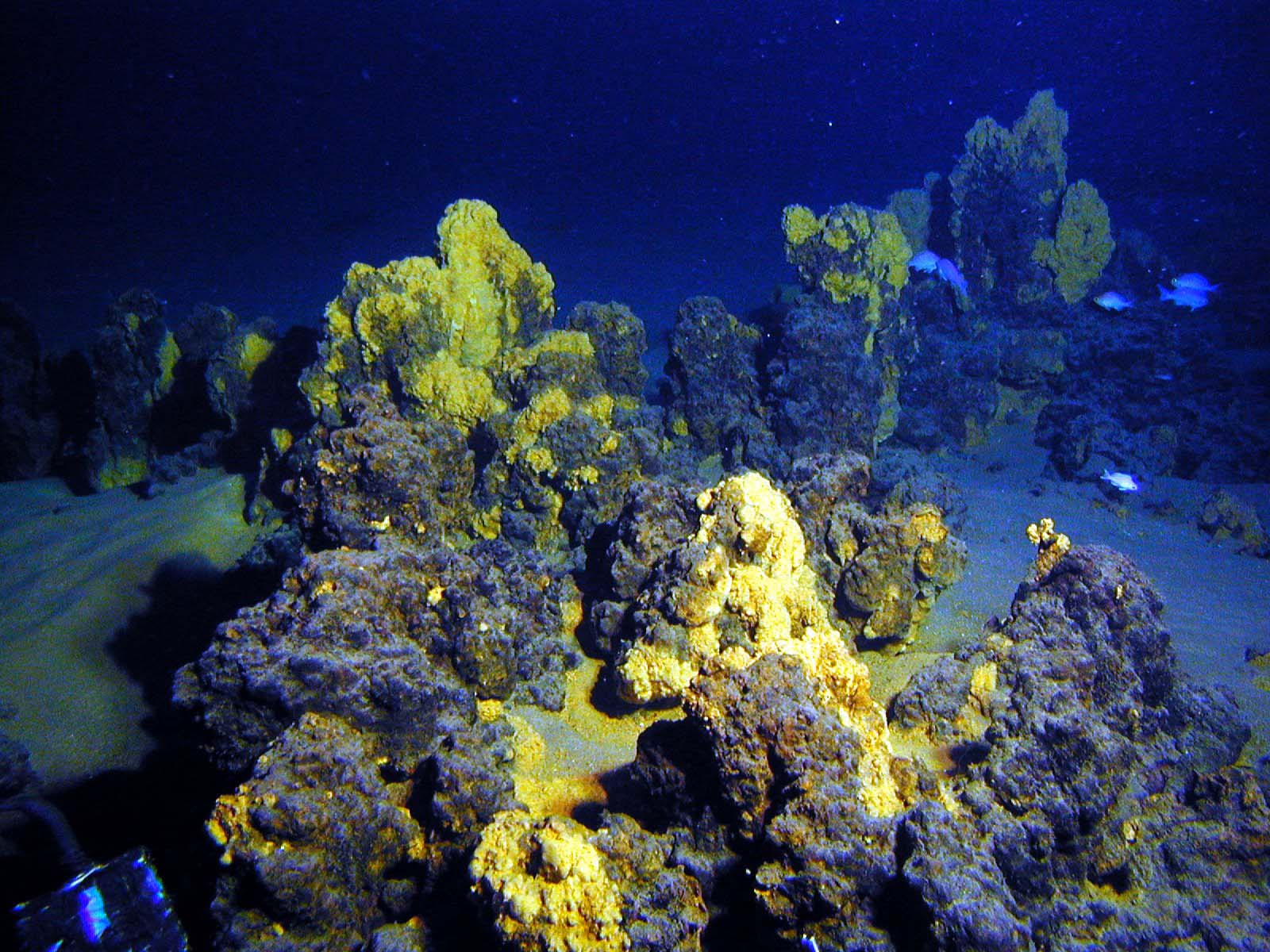
[Image description: A photo of a hydrothermal vent. The background is dark blue with several fish to the right of it. The vent itself appears to be a collection of rocks, bright yellow in some places. End description.]
Good evening, all! I hope everyone is well. Before I begin today, I’d just like to say that there will be no discussion of the coronavirus on this blog. The news is rapidly changing, and I don’t want to accidentally perpetuate misinformation. Unlike some people, including people with a lot of authority and absolutely none of it in science, I’m trying to be responsible about the information I share in this uncertain time. (Incidentally, please do not ingest chloroquine phosphate, or any other medication, unless it has been specifically prescribed to you. This includes the version of the medication intended for fish.)
Having said that…
Some exciting ocean news for everybody today! After nine years spent studying the deep sea off the coast of Angola, we now have evidence that there are communities of deep ocean fish that migrate! The data in this study was gathered using the Deep-ocean Environmental Long-term Observatory System (DELOS), created and maintained through the collaboration of various governments, universities, and industries. One purpose of DELOS is to broaden our understanding of the ocean so that human impact can be better understood, and acquisition of oil made safer for humans and the ocean. Using cameras, sensing equipment, and even satellites, researchers noticed that populations of fish would move with seasons. You may be wondering, “How does a fish almost 5,000 feet from the surface and any amount of sunlight know what season it is?” The answer is…nutrients!
The basic principle of gravity, (what goes up must come down), also applies to the ocean. What happens up top – such as algal blooms, eventually drifts to the ocean floor. Because of the lack of sunlight, nutrients at the bottom of the ocean are generally and severely limited. Nutrient availability on the surface varies with the seasons because sunlight is the basis for the food chain. Sunlight feeds algae, algae feeds krill, krill feed fish, and so on. This study suggests that deep-ocean fish will follow sources of nutrients on top of the ocean, with a lag time. The lag time accounts for the amount of time it takes for nutrients from the top to reach the bottom of the ocean, which can take months. (The smallest of sediments and particles can take over fifty years to settle, according to my oceanography professor!) Without understanding the activity on top, the cause of the movement would otherwise be difficult to understand. This is important because it demonstrates that even 5000 feet down, deep-ocean life can still be affected by what occurs on the surface of the sea, months to years after the fact! DELOS is set to be a twenty-five year study, so who knows what else might come of this collaborative effort?
You know, we used to think that nothing could live at the bottom of the ocean. Well, some of “we”, anyway. This was called the Azoic or Abyssus theory. It was proven wrong. We used to think that photosynthesis was the only way autotrophs (mainly plants) could exist – and plants form the basis of most food chains. Then deep-sea hydrothermal vents were discovered. With no light at all, the organisms surrounding them use chemosynthesis to survive. At every turn, the ocean surprises us. Life on Earth is an incredibly resilient, stubborn thing. You’re part of that great tradition of resilience, too. Don’t count yourself out just yet. There’s not a whole lot I alone can say to make this unprecedented situation less terrifying to live in. But I can tell you about the ocean, and the ocean has a lot to say about what we’re capable of, especially when we work together. Please take care.
 Thoughts of an Aspiring Biologist